Water feels simple when it comes from a tap. But the journey behind every glass is long: rain, soil, tanks, lakes, rivers, aquifers, pipes, treatment, storage, and daily human care. When any part of that chain is damaged, families feel it first.
The global water picture is serious. UN-Water and WHO/UNICEF data show that billions still live without safe water, sanitation, or hygiene services. The UN World Water Development Report 2024 noted that 2.2 billion people lacked safely managed drinking water in 2022, and the 2025 WHO/UNICEF update says 2.1 billion people still lacked safely managed drinking water in 2024. Water demand has also been rising for decades, while agriculture uses roughly 70% of global freshwater withdrawals. This is why water conservation is not only an environmental message; it is a health, food, education, and livelihood message.
India depends deeply on groundwater. The Central Ground Water Board's 2025 assessment estimated India's annual groundwater recharge at 448.52 BCM, annual extractable groundwater resource at 407.75 BCM, and annual extraction at 247.22 BCM. The national stage of groundwater extraction was 60.63%. That average hides local stress: 730 assessment units were over-exploited, 201 critical, and 758 semi-critical.
Tamil Nadu understands this pressure. CGWB's 2023 assessment, widely reported from the official report, estimated that Tamil Nadu extracted about 73.91% of its annual extractable groundwater, with several districts crossing 100%. A Tamil Nadu Water Resources Department assessment reported that 57% of surveyed firkas were over-exploited, critical, or semi-critical. In simple words: many places are drawing water faster than nature can refill it.
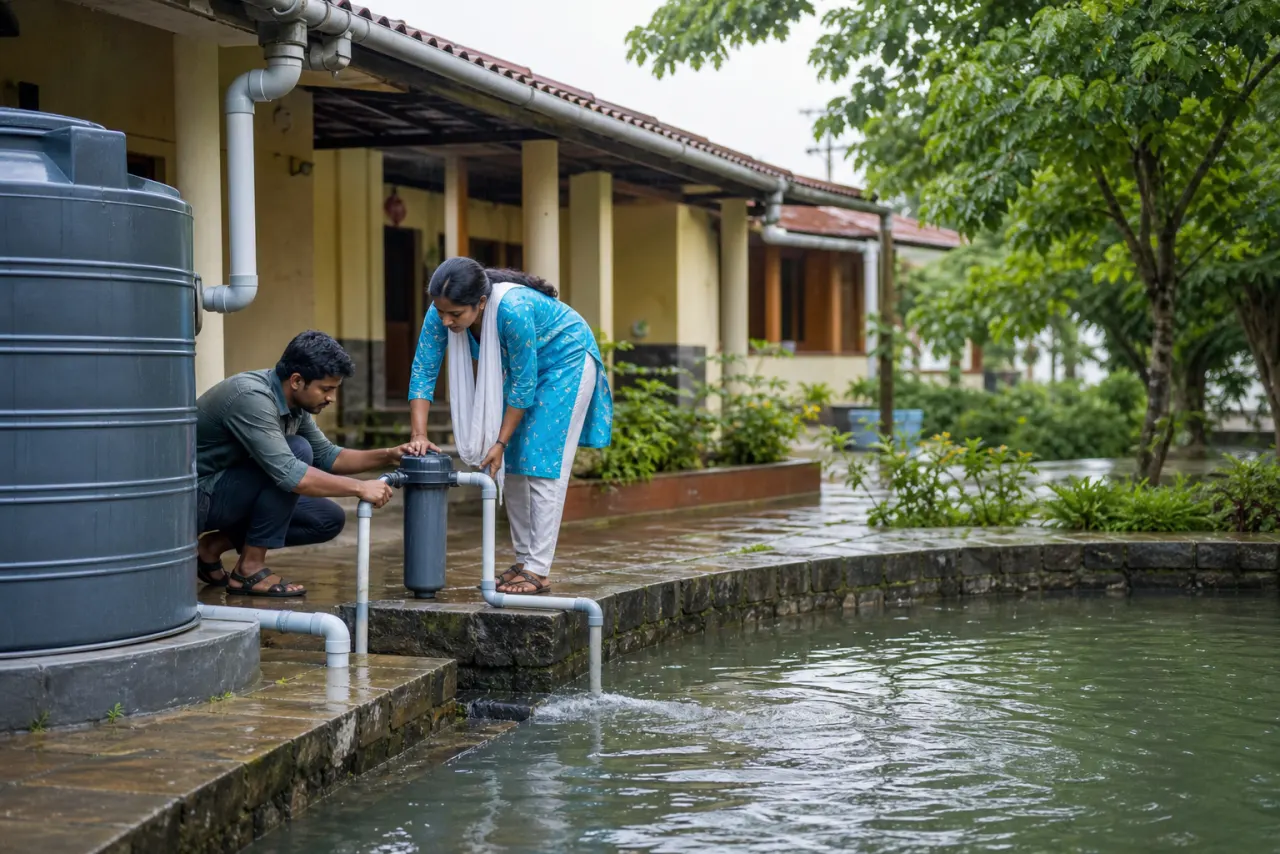
Rainwater harvesting is one of the most practical answers. A roof can become a catchment. A school can recharge a borewell. A temple tank, village pond, farm pond, or street-side recharge pit can hold monsoon water instead of letting it rush away. But rainwater harvesting works only when it is maintained: gutters must be cleaned, first-flush systems used, filters checked, recharge pits desilted, and overflow routed safely.
Water quality needs the same seriousness. A full tank is not enough if the water is polluted. Do not dump waste into ponds, canals, drains, or open land. Keep sewage away from stormwater lines. Avoid overuse of fertilizers and chemicals near wells and waterbodies. Cover storage tanks. Clean sumps regularly. Test borewell and drinking water when taste, smell, colour, or illness raises concern.
Every household can start small: fix leaks, reuse RO reject water for cleaning, water plants early morning, choose buckets over running taps, harvest roof rain, and protect nearby waterbodies. Communities can go further: map local wells, clean feeder channels before monsoon, revive tanks, plant native trees near water sources, and report illegal dumping.
Water is not someone else's department. It is the common inheritance of every child, farmer, worker, student, and family. If we save rain, respect groundwater, and keep water sources clean, we do more than conserve a resource. We protect health, dignity, and the future.
Sources: UN-Water and WHO/UNICEF WASH updates; UNESCO UN World Water Development Report 2024; Central Ground Water Board / Ministry of Jal Shakti Dynamic Ground Water Resources Assessment 2025; Tamil Nadu groundwater assessments reported from CGWB and WRD data.

MAGIBAN FOUNDATION
Transforming Lives • மாறுவோம் மாற்றுவோம்
- Call: +91 96200 73257
- Email magiban.ngo@gmail.com
Blog Details
01 AUG
Water Is Everyone's Work: Save, Harvest, Protect
Transform Lives With MAGIBAN Foundation
Join hands with us to bring meaningful social change in education, healthcare, and road safety.